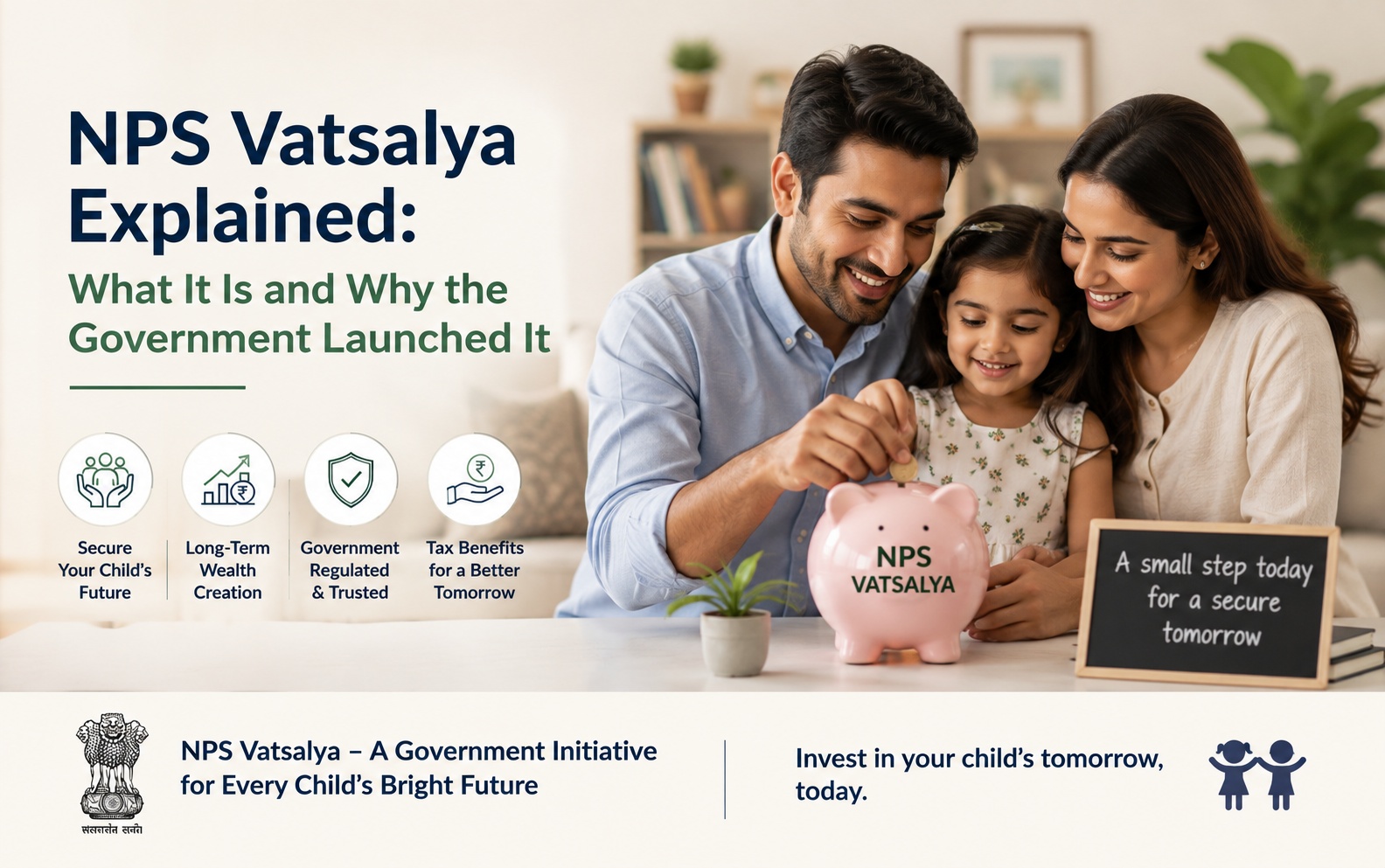


You must have already heard of NPS Vatsalya, now let’s understand what NPS Vatsalya is, here’s a simple answer: it’s a market-linked long-term investment scheme for minors. The parent or legal guardian opens and invests regularly in the account until the child turns eighteen, after which the child takes over as an adult subscriber.
Announced in the Union Budget 2024–25, the scheme was officially launched on 18 September 2024 and is regulated by the Pension Fund Regulatory and Development Authority (PFRDA) under the regulations of Vatsalya scheme.
What Is NPS Vatsalya?
NPS Vatsalya is a market-linked pension account that allows parents or guardians to invest for a minor’s long-term financial future.
In essence of the NPS Vatsalya, is not meant for the parent; it belongs to the child, with the parent acting as the contributor or custodian. Contributions are invested by a pension fund chosen during the opening of the account, and returns depend on market performance, connecting four key entities: the minor subscriber, the guardian, the regulator PFRDA, and the pension fund.
When Was NPS Vatsalya Launched?
The scheme was announced in the Union Budget 2024–25 and officially launched on 18 September 2024 by the Government of India.
Why Did the Government Launch NPS Vatsalya?
NPS Vatsalya is a unique plan where the parent can start by investing a small amount monthly and let it grow over years. Letting parents open an account from a child’s early years, giving decades of extra investment time before the child grows into an adult.
The broader goal is to encourage early financial planning, build awareness to start early, and create continuity between childhood savings and adult future planning. This fund can later be used by the child for higher education or starting a venture or any other life goal.
To Encourage Saving from an Early Age
Regular contributions are made while a child is young get more time to potentially grow through compounding. The scheme does not, however, promise a fixed or guaranteed return. This fund can be used for higher education of the child and does not create a sudden financial set back to the family
To Improve Financial Literacy
Growing up with a structured investment account can help a child understand the value of saving, investing, and long-term planning well before they start earning. This boost confidence in the child himself and they would continue to make smarter financial decisions.
To Build Long-Term Financial Security
The scheme is meant to build a financial foundation when the child would need money for colleges and pursuing other ambitions, not fund short-term needs.
To Support a Pension-Aware Society
It also supports the government’s wider goal of increasing pension participation and awareness across age groups.
How Does NPS Vatsalya Work?
- A parent or legal guardian opens the account in the minor’s name.
- The minor receives a Permanent Retirement Account Number (PRAN).
- Contributions are invested through a chosen pension fund and investment option.
- The account stays market-linked throughout.
- Once the child turns 18, they can review their options at that stage, whether to withdraw or continue the account.
Documents Required to Open an NPS Vatsalya Account
Since the account is opened for a minor but operated by an adult, both the child’s and the guardian’s documents are needed. Exact formats can vary slightly depending on the CRA or Point of Presence you choose.
For the child - any one proof of date of birth: birth certificate, school leaving/matriculation certificate, passport etc, that is available.
For the parent or guardian - standard KYC through Aadhaar or CKYC, including identity proof, address proof, and PAN. A court-appointed legal guardian must also submit the relevant court order. KYC is completed online within minutes
Bank account: optional at account opening for resident Indians, though it’s required later for partial withdrawals or exit; it’s mandatory upfront for NRI or OCI applicants.
How Is NPS Vatsalya Different from Regular NPS?
NPS Vatsalya is opened for a minor and operated by a guardian, while regular NPS is opened and managed by an adult subscriber.
NPS Vatsalya focuses on starting long-term investment during childhood that helps primarily in accumulating funds for the life goals of the child. Not necessarily a retirement fund. Regular NPS account primarily supports retirement planning during adulthood.
What Happens When the Child Turns 18?
After turning 18, the subscriber remains in NPS Vatsalya for up to 3 years (till 21), unless he/she chooses to exit or shift to NPS All Citizen Model or any other applicable model. Fresh KYC, including nominee details and any other stipulated details, is mandatory. Post KYC, the subscriber may choose to:
• Seamlessly shift the entire corpus to NPS (All Citizen Model or other applicable model), OR
• Withdraw up to 80% as a lump sum and use the balance to purchase an annuity, OR
• Withdraw 100% of the corpus if the total amount is less than ₹8 lakh.
Fresh KYC must be completed by the age of 18 to 23 if they want to continue with the account. The account can then continue under applicable NPS rules, transition to a regular NPS account, or exit as per the guidelines in force at that time so it’s worth checking the latest rules closer to the transition date.
Who May Consider NPS Vatsalya?
It may suit young parents wanting a disciplined, long-term, market-linked investment for their child, and who are comfortable with returns that move with the market.
It may not suit families seeking guaranteed returns, unrestricted access, or funds for immediate expenses.
Conclusion
NPS Vatsalya was introduced to encourage continuous early saving and investment for the child’s future planning. Before investing, understand the scheme’s market-linked nature, contribution rules, and withdrawal conditions.
FAQs on NPS Vatsalya
Is NPS Vatsalya a pension scheme for children?
NPS Vatsalya, market-linked investment account for a minor, managed by a parent or legal guardian. The fund can be used anytime when the child turns 18. They can choose to either withdraw the amount or convert it to a regular NPS account.
Why did the Government introduce NPS Vatsalya? To encourage early saving, improve financial literacy, and build long-term investment awareness.
Is NPS Vatsalya the same as regular NPS?
No. NPS Vatsalya is for minors and operated by a guardian; regular NPS is for adult subscribers.
What happens to NPS Vatsalya when the child turns 18?
Continue under NPS Vatsalya: The account can continue under the NPS Vatsalya framework for up to 3 more years (till age 21), allowing investments to keep growing.
Shift to NPS All Citizen Model: The account can be transitioned into a regular NPS Tier-I account under the All Citizen Model, giving the subscriber full independent control going forward.
Exit completely: The subscriber can choose to exit the scheme. Withdraw the entire corpus as a lump sum if the total accumulated amount is ₹8 lakh or less. If more, then withdraw up to 80% of the corpus as a lump sum, with the remaining 20% used to purchase an annuity
Disclaimer
Past performance may or may not be sustained in future and should not be used as a basis for comparison with other investments. Returns under NPS are subject to market risk and are prone to fluctuation depending on the state of the Financial market.
Investors are advised to consult their own legal, tax and financial advisors to determine possible tax, legal and other financial implication or consequence of subscribing to the schemes of DSP Pension Fund Managers Private Limited. Tax laws are subject to change.