Retail NPS

#INVESTFORGOOD

Join NPS

What is Retail NPS?

The retail sector NPS allows individual to open their account and invest via regular contributions. These contributions are further invested in various market-linked assets like equities, corporate bonds, and government funds as per the choice of the individual.
The retail sector NPS allows individual to open their account and invest via regular contributions.
These contributions are further invested in various market-linked assets like equities, corporate bonds, and government funds as per the choice of the individual.

NPS helps you manage your savings today, to secure your future. Pave the road to your second innings with easy saving plans.

Read More

Who can open a Retail NPS account?

  • All the citizens of India, including OCIs (Overseas Citizens of India) and NRIs.
  • Individuals must be between the ages of 18 to 85 years at the time of registration.
  • The subscribers must successfully comply with the KYC requirements.

How Retail NPS Work?

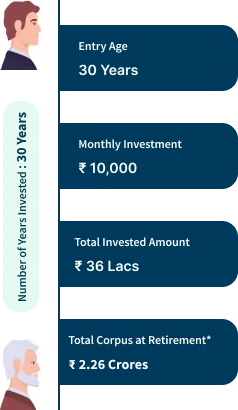
At 30 years of age, Nakul invests ₹10,000 monthly in NPS for a secure retirement and tax benefits, aiming for life goals.

*Assuming growth rate at 10%

How to Join Retail NPS?

Joining NPS is made very easy and by following 3 simple steps you can start your retirement planning. Just follow these three steps below.

  • Click here to fill in your personal details.
  • Upload your PAN, Copy of your signature and cancelled cheque.
  • Make online investment and your PRAN is created.

What are the Tax Benefits in Retail NPS?

  • NPS provides generous tax deductions up to Rs. 1.5 lakhs under Section 80C.
  • An additional deduction of Rs. 50,000 under Section 80 CCD(1B), allowing investors to save more.

Frequently Asked Questions on about Retail NPS?

Here are some frequently asked questions about Retail NPS

Account Types & Eligibility

Yes, NRIs and OCIs can open a Retail NPS account. Contributions are subject to RBI and FEMA regulations.

The minimum contribution is ₹500 per contribution and ₹1,000 per year for Tier I. Tier II requires a minimum of ₹250 per contribution with no annual minimum.

Tier I is a mandatory pension account with restricted withdrawals and tax benefits. Tier II is a voluntary savings account with no withdrawal restrictions but no tax benefits.

Investments, Fees & Tax Benefits

Funds are managed by PFRDA-registered Pension Fund Managers across asset classes: Equity (E), Corporate Bonds (C), and Government Securities (G. You can choose Active or Auto choice or schemes under Multi Scheme Framework.

DSP Pension works under PFRDA rules and has built a strong record of managing pension funds, offering a mix of investment choices that fit your needs.

Fund management charges are capped at 0.12% per annum, making it one of the lowest-cost investment products. Additional PoP, custodian and CRA minimal charges are applied.

Contributions up to ₹1.5 lakh are eligible for deduction under Section 80CCD(1), within the overall 80C limit. An additional ₹50,000 deduction is available exclusively under Section 80CCD(1B).

Yes, an exclusive additional deduction of ₹50,000 is available under Section 80CCD(1B), over and above the ₹1.5 lakh 80C limit. This means a total deduction of up to ₹2 lakh is possible through NPS alone.

At maturity, 60% of the corpus withdrawn as a lump sum is tax-free. The remaining 40% used to purchase an annuity is tax-exempt, but the annuity income received is taxable.

Withdrawal & Exit Rules

Premature exit (before age 60) requires at least 80% of the corpus to be used for annuity purchase, and only 20% can be withdrawn as a lump sum. This is allowed only after completing 5 years in NPS.

Normal withdrawal is allowed at age 60 or superannuation. You can defer withdrawal up to age 85, and partial withdrawals (up to 25%) are allowed after 3 years for specific purposes like illness, education, or home purchase.