

While the National Pension System (NPS) is meant to create a market-linked retirement corpus for eligible Central Government employees, Unified Pension Scheme combines personal contributions, plus a conditional assured payout. The debate between NPS vs. UPS goes beyond higher returns versus a guaranteed pension, qualifying service, contributions, risks, and payouts at retirement and beyond are all important factors.
The short answer is, depending on individual circumstances, choosing NPS could be ideal for those who want a market-linked retirement corpus and to own their retirement savings, while UPS is better for employees who want an assured pension and to rely on the government to manage their retirement corpus.
Before jumping to conclusions, let’s first answer the most important question regarding NPS and UPS:
Are you eligible to choose between the two schemes?
Only eligible Central Government employees can choose between NPS and UPS. Furthermore, UPS was notified from 1 April 2025 as an optional scheme under NPS and is available to those who are covered under NPS. It is not a separate scheme for non-governmental employees or those who are not under NPS. NPS is mandatory for many State Government employees; however, unless separately notified, UPS will not apply to them.
Now, what exactly are NPS and UPS?
NPS stands for the National Pension System, a defined-contribution, market-linked pension scheme where government employees contribute 10% of their basic pay and Dearness Allowance (DA) and the government adds 14% to their NPS Tier I account. These pension fund managers manage the subscriber’s money, and therefore, the corpus depends on contributions and investment returns.
Unified Pension Scheme is an option under NPS that comes with a conditional assured payout. An employee contributes 10% of their basic pay and DA, the government adds 10% to the individual’s corpus and approximately 8.5% to a pool corpus for the benefit of subscribers under the scheme. Therefore, calling it an 18.5% contribution to the subscriber’s account would not be accurate. The table below lists the key differences between NPS and UPS.
NPS vs. UPS: Key Differences Government Employees Must Know
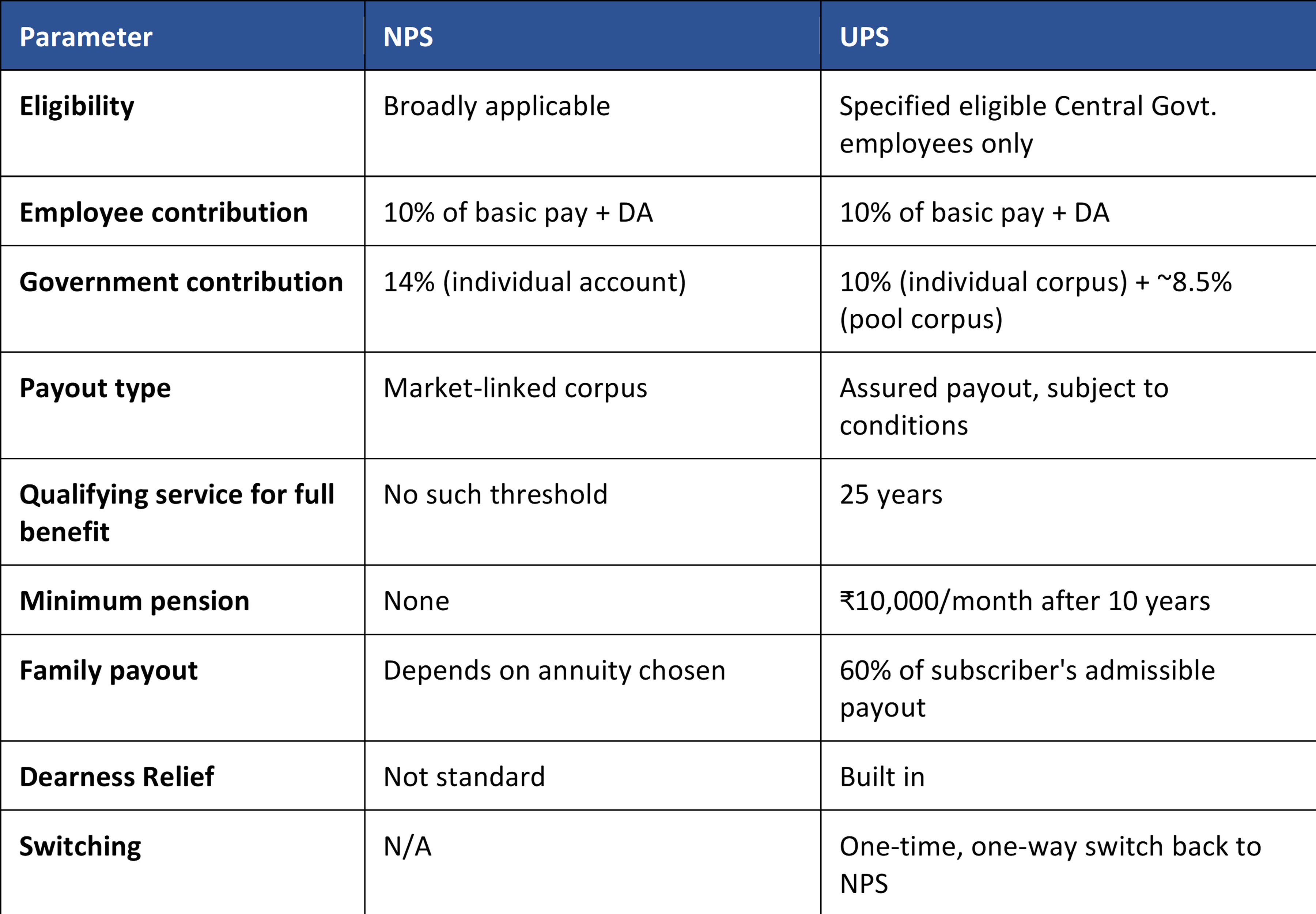
While NPS offers flexibility to the subscriber to choose between annuity and corpus withdrawal at retirement, UPS offers the choice between annuity and a partial withdrawal. There are also significant differences, such as the qualifying years for minimum pension, family pension, Dearness Allowance, switching provisions, NPS withdrawal, etc. The following section will explore the retirement benefits and other considerations related to NPS and UPS.
How Is Pension Calculated Under NPS and UPS?
NPS
NPS does not have a pension formula because pensions depend on the subscriber’s accumulated wealth, annuity choice at retirement, and annuity providers’ terms. In contrast, there is a standard formula to calculate the assured pension under UPS.
UPS Assured Pension Formula
Assured pension under UPS = P × (Q/300)
Where,
P = average basic pay for the last 12 months
Q = completed qualifying-service months, not exceeding 300 months
For example, if Mr. A had an average basic pay of ₹60,000 and completed 300 qualifying months, his assured pension would be ₹60,000 × (300/300) = ₹60,000 per year, or ₹5,000 per month. In addition, Mr. A is entitled to family pension benefits under UPS. Assuming he has a legally wedded wife, the family pension would be 60% of his pension. Additionally, Dearness Relief is also applicable for subscribers under UPS.
It is important to note that while the assured pension component of UPS is standardised, it is not entirely guaranteed. The admissible pension could reduce for various reasons. Furthermore, while a subscriber accumulates wealth individually under NPS that can be converted to an annuity upon retirement, UPS subscribers do not have this option. There are two main reasons for this restriction:
-
If a subscriber’s individual corpus is less than the benchmark corpus, the admissible pension will decrease
-
A subscriber can take a maximum of 60% of the corpus as a withdrawal upon retirement. This will reduce the annuity amount.
Retirement Withdrawals, Lump-Sum, and Final Pension
NPS subscribers with more than ₹12 lakh in pension wealth at retirement must utilise at least 40% to purchase an annuity. The remaining 60% can be withdrawn as a lump sum. In contrast, UPS subscribers can withdraw up to 60% of their pension corpus as a lump sum upon retirement, with the annuity reduced proportionally.
With respect to family pension, NPS subscribers can claim monthly pension payments or a pension commutation at the time of retirement based on their nominees/legal heirs.
However, under UPS, family pension is payable to the legally wedded spouse. It is also important to note that UPS subscribers are entitled to an additional lump-sum payment that is equal to one-tenth of the last drawn basic pay plus DA for every six completed months of service. This benefit is separate from final pension withdrawals and is also not available to NPS subscribers.
Other Differences Between NPS and UPS
Factor National Pension System Unified Pension Scheme
Family pension Depends on annuity choice, nominees/legal heirs 60% of subscriber’s admissible pension (only for a legal wedded spouse)
Dearness Relief Applicable only for Dearness Allowance (DA) included in pension Not applicable separately, built into the pension
Switching/Withdrawals not applicable Can be withdrawn as a lump sum (only once) on retirement
Additional pension ₹5,000/month (subject to ceiling) Additional ₹5,000/month on the corpus withdrawal
Inflation-linked pension N/A Assured pension adjusted for inflation
Can Government Employees Still Choose Between NPS and UPS in 2026?
The general option period for existing employees and eligible retirees was extended till 30 November 2025, after which there has been no further extension. Therefore, government employees who did not exercise the option by 30 November 2025 remain under the NPS. However, for new recruits, there is a 30-day window from the date of joining to exercise the option to join UPS, unless further extended by the government.
Can You Switch from UPS to NPS?
Yes, a subscriber can switch from UPS to NPS once. The following conditions must be met when initiating the switch:
-
At least 12 months before the date of superannuation, or
-
At least three months before voluntary retirement, or
-
At the time of resignation or compulsory retirement under FR 56(j) not involving penalty
The switch to NPS is not available to subscribers undergoing disciplinary proceedings. Once the switch is done, a subscriber cannot revert to UPS.
NPS vs. UPS: What Should Government Employees Choose?
As mentioned earlier, the choice between NPS and UPS depends on qualifying service, retirement options, investment risk, assured monthly pension, and family benefits. The government employee must evaluate their retirement horizon based on eligibility and expected retirement age. Here is a general guide to help choose between NPS and UPS:
NPS Might Be a Better Option If you want a higher government contribution to your individual NPS account
- you feel comfortable taking on market risks to increase your retirement corpus and have an identified corpus withdrawal at retirement
- you do not expect to have a long career in government service
- you want a larger pension commutation at retirement and more flexibility in investment options-
UPS Might Be a Better Option If
- you can serve for at least 25 years under the government
- you prefer a predictable, assured monthly pension and want to rely on the government to manage your retirement corpus
- it is important for you to have a pension for your spouse upon your retirement or death, and you do not mind having a smaller corpus withdrawal at retirement
- you will not need a large final withdrawal that can reduce your monthly pension
NPS vs. UPS: An Example Scenario to Help You Understand
An employee has a long career ahead
An employee who expects to have a long government career ahead should consider opting for UPS because it has a qualifying service for the minimum pension and family pension. With 25+ years of service, the assured pension component under UPS could be substantial along with the family pension and dearness relief.
An employee has a short career ahead
In contrast, an employee who does not expect to have a long government career ahead should assess their own circumstances and decide whether to stay under NPS or move to UPS. The longer one stays under NPS, the higher their retirement corpus will be, but the outcome still depends on market risks. The employee should evaluate the risk versus reward trade-off and consider switching to UPS if they foresee a short career under the government.
Conclusion: NPS vs. UPS
While NPS is ideal for subscribers with an extended career who want to rely on market risks to build their retirement corpus, the assured pension of UPS is better for employees who will serve for at least 25 years and want to depend on the government for a stable, predictable pension. Eligibility, retirement corpus, withdrawal at retirement, family pension, and inflation considerations should all be weighed before choosing between NPS and UPS.
FAQs on NPS vs. UPS
Is the choice between NPS and UPS available to all government employees?
Only eligible Central Government employees can choose between NPS and UPS. Furthermore, UPS only applies to those who are covered under the NPS. It is not a separate scheme for non-governmental employees or those who are not under NPS. NPS is mandatory for many State Government employees; however, unless separately notified, UPS will not apply to them.
Does the assured pension under UPS offer 50% of the last salary?
The assured pension under UPS is not necessarily half of an employee’s last salary. Rather, it is equal to half of the average basic pay for the subscriber’s last 12 months of service after completing 25 years of qualifying service and is subject to reduction for various reasons outlined in the rules.
What happens if a subscriber under UPS has worked for less than 25 years?
A subscriber must complete at least 10 years of qualifying service to be eligible to receive the assured pension. For every year of service between 10 and 25 years, the pension is paid at an increasing rate till the 25th year.
Can someone change from the Unified Pension Scheme to the National Pension System?
Yes, subscribers can switch from the Unified Pension Scheme to the National Pension System once. The switch is not available to subscribers under disciplinary action. The switch can be made if at least 12 months have passed since joining NPS, or three months have passed since joining NPS after voluntary retirement, or at the time of resignation or compulsory retirement under FR 56(j) not involving penalty.
What happens to assured pension benefits upon resignation?
Ordinary resignation results in forfeiture of assured pension benefits. However, special circumstances may allow transfer of pension to another government organisation upon approval.
Disclaimer
Past performance may or may not be sustained in future and should not be used as a basis for comparison with other investments. Returns under NPS are subject to market risk and are prone to fluctuation depending on the state of the Financial market.
Investors are advised to consult their own legal, tax and financial advisors to determine possible tax, legal and other financial implication or consequence of subscribing to the schemes of DSP Pension Fund Managers Private Limited. Tax laws are subject to change.