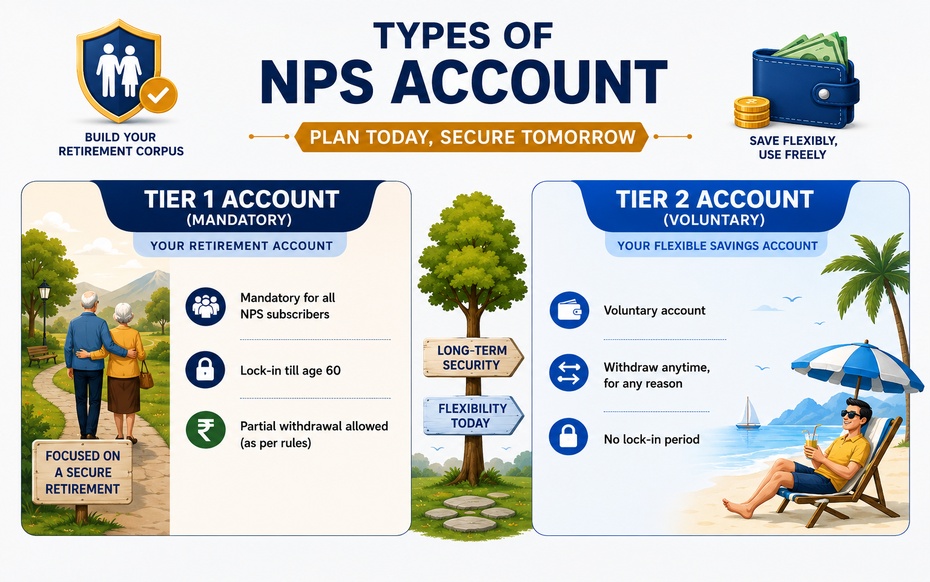


There are 2 types of NPS account – Tier 1 and Tier 2. The Tier 1 account is a mandatory account which comes with restrictions on withdrawals as compared to your Tier 2 account. Knowing the key differences between NPS Tier 1 and Tier 2 can help you plan your retirement savings better.
What is the NPS Tier 1 and Tier 2 Accounts?
The main difference between NPS Tier 1 and Tier 2 accounts is that the former one is mandatory and has certain restrictions on withdrawals while the latter one is an optional and flexible savings account. NPS has two tiers so that subscribers can segregate their retirement funds from their flexible savings. NPS Tier 1 is designed to encourage systematic investments and long-term savings. NPS Tier 2 account is an optional account where you can park your money and earn market-linked returns.
What is an NPS Tier 1 account?
NPS Tier 1 account is the main retirement savings account which comes with benefits of tax deduction and long-term investment horizon. It is mandatory for all subscribers and has restrictions on withdrawal. An individual needs to make at least a contribution to keep the account active.
What is an NPS Tier 2 account?
NPS Tier 2 account is a voluntary savings account which can only be opened by subscribers who have an active Tier 1 account. NPS Tier 2 account withdrawal rules permit unrestricted withdrawals, unlike the Tier 1 account. There are no restrictions or limitations on contributions and withdrawals for this account.
NPS Tier 1 vs Tier 2 accounts: Difference
The difference between NPS Tier 1 and Tier 2 accounts is that the former one is your mandatory retirement savings while the latter one is your optional savings account. This difference creates differences in eligibility criteria, minimum contributions, lock-in period, tax benefits, and withdrawal rules. The decision to choose NPS Tier 1 vs Tier 2 depends on your objective to save for retirement or to make flexible investments. The following table explains the key difference between NPS account tier 1 and tier 2:
Feature
Tier 1 Account
Tier 2 Account
Account type
Mandatory retirement savings account
Voluntary and optional savings account
Minimum opening contribution
Rs. 500
Rs. 1,000
Minimum annual contribution
Rs. 1,000 to keep active
Nil, if Tier 1 account is active
Lock-in period
Until the age of 60
No lock-in
Withdrawal flexibility
Some limited withdrawals are permitted like withdrawal of own contribution up to 25% in case of medical emergency or for children’s education after 3 years
Like a regular savings account, unrestricted withdrawals are permitted at any time
Tax benefits
Applicable on contributions under section 80C / 80CCD
Limited tax benefits available only if a government employee makes an investment with a lock-in period of 3 years
Annuity requirement at exit
At least 40% of the corpus must be used to purchase an annuity
No such requirements
Eligibility
Any eligible citizen can open this account directly at the start
Only a subscriber with an active Tier 1 account can open this account
Eligibility & Opening of NPS Account
Any citizen of India, resident or non-resident, of age 18 to 70 years can open a Tier 1 account directly. However, you can only open a Tier 2 account if you have an active Tier 1 account.
Minimum Contribution Rules
To open a Tier 1 account, you need to make a minimum contribution of Rs. 500. Additionally, you need to contribute at least Rs. 1,000 every financial year to keep your Tier 1 account active. To open a Tier 2 account, you need to make a minimum contribution of Rs. 1,000. However, there is no minimum contribution requirement for a Tier 2 account after opening if your Tier 1 account is active.
Lock-in Period and Liquidity
There is a significant difference in the withdrawal rules of NPS Tier 1 vs Tier 2 accounts. Under a Tier 1 account, the subscriber cannot withdraw the contributions before retirement with limited exceptions. A Tier 2 account provides complete liquidity; subscribers can make any withdrawal at any time unlike a Tier 1 account.
Tax Benefits of NPS Tier 1 and Tier 2 Accounts
The tax benefits under NPS are only available for Tier 1 account. The contribution to this account is eligible for deduction under section 80C and 80CCD for resident individuals and for tax-saving benefits up to Rs. 50,000 for NRI subscribers. The subscriber can claim additional tax benefit of Rs. 50,000 under section 80CCD(1B) on contribution to the Tier 1 account. The tax benefit under NPS for Tier 2 account is limited to the contribution made by government employees with a lock-in period of 3 years.
Withdrawal Rules for NPS Tier 1 and Tier 2 Accounts
Yes, you can withdraw from both NPS Tier 1 and Tier 2 accounts but the withdrawal rules are significantly different for the two accounts.
The Tier 1 account allows limited withdrawals after 3 years from the date of contribution. The withdrawal will be limited to 25% of your own contribution to the Tier 1 account for medical emergency, or for higher education of your children. On the other hand, the withdrawal from a Tier 2 account can be claimed anytime for any purpose as there are no restrictions or limitations.
Investment Flexibility and Asset Allocation for Tier 1 and Tier 2 Accounts
Yes, you can choose different asset allocation for your Tier 1 and Tier 2 accounts. Under NPS, you can choose the asset allocation for your retirement corpus based on your risk appetite. You can make different investment options of equity, corporate bonds, and government securities for different Tier 1 or Tier 2 accounts.
Transfer of Funds Between NPS Tier 1 and Tier 2 Accounts
You can transfer funds from one NPS account to another but the transfer rules are different for Tier 1 and Tier 2 accounts. Your Tier 2 account balance can be transferred to Tier 1 account to claim additional tax deductions under section 80CCD(1B) or (2). However, the balance in Tier 1 account cannot be transferred to Tier 2 account.
NPS Tier 1 or Tier 2: Which Account Should You Choose?
The subscribers should consider their objective to choose between the NPS Tier 1 and Tier 2 accounts. If your objective is to set a systematic retirement corpus, you can invest in a Tier 1 account. If you want to make flexible market-linked investments you can choose to invest in a Tier 2 account. Most of the investors usually open both accounts and invest in them for different purposes.
Frequently Asked Questions About NPS Tier 1 and Tier 2
1. Can I have both NPS Tier 1 and Tier 2 accounts?
Yes, you can have both the accounts as a subscriber because a Tier 2 account can only be opened with an existing active Tier 1 account. Both the NPS accounts come under the same Permanent Retirement Account Number (PRAN) but have different rules for contribution, withdrawal, and investment.
2. Can I open a Tier 2 NPS account without a Tier 1 account?
No, you cannot open a Tier 2 account without a Tier 1 account because the former one is an optional savings account and the latter one is a mandatory retirement savings account. The Tier 2 account can only be opened by a subscriber who has an active Tier 1 account.
3. Can I convert my NPS Tier 1 account into a Tier 2 account?
No, you cannot convert your NPS Tier 1 account into a Tier 2 account because Tier 1 and Tier 2 accounts are two different accounts. The conversion from one type of account to another is not permissible as both the accounts exist under one PRAN.
4. Can I nominate someone to my Tier 1 and Tier 2 NPS accounts?
Yes, you can nominate someone to your Tier 1 and Tier 2 NPS accounts. As a subscriber, you have the option to update or change the nominee details at any point in time. It is always preferable to update nominee details for both NPS accounts.
5. What happens to my NPS Tier 1 account on death?
The nominee or legal heir will get the corpus amount transferred into their bank account as per the instructions mentioned in the Tier 1 account. The nominee will receive the complete amount as there are no restrictions or limitations on withdrawals and claims upon the death of the subscriber.
Disclaimer
Past performance may or may not be sustained in future and should not be used as a basis for comparison with other investments. Returns under NPS are subject to market risk and are prone to fluctuation depending on the state of the Financial market.
Investors are advised to consult their own legal, tax and financial advisors to determine possible tax, legal and other financial implication or consequence of subscribing to the schemes of DSP Pension Fund Managers Private Limited. Tax laws are subject to change.